
Best Seller Icon Bestseller

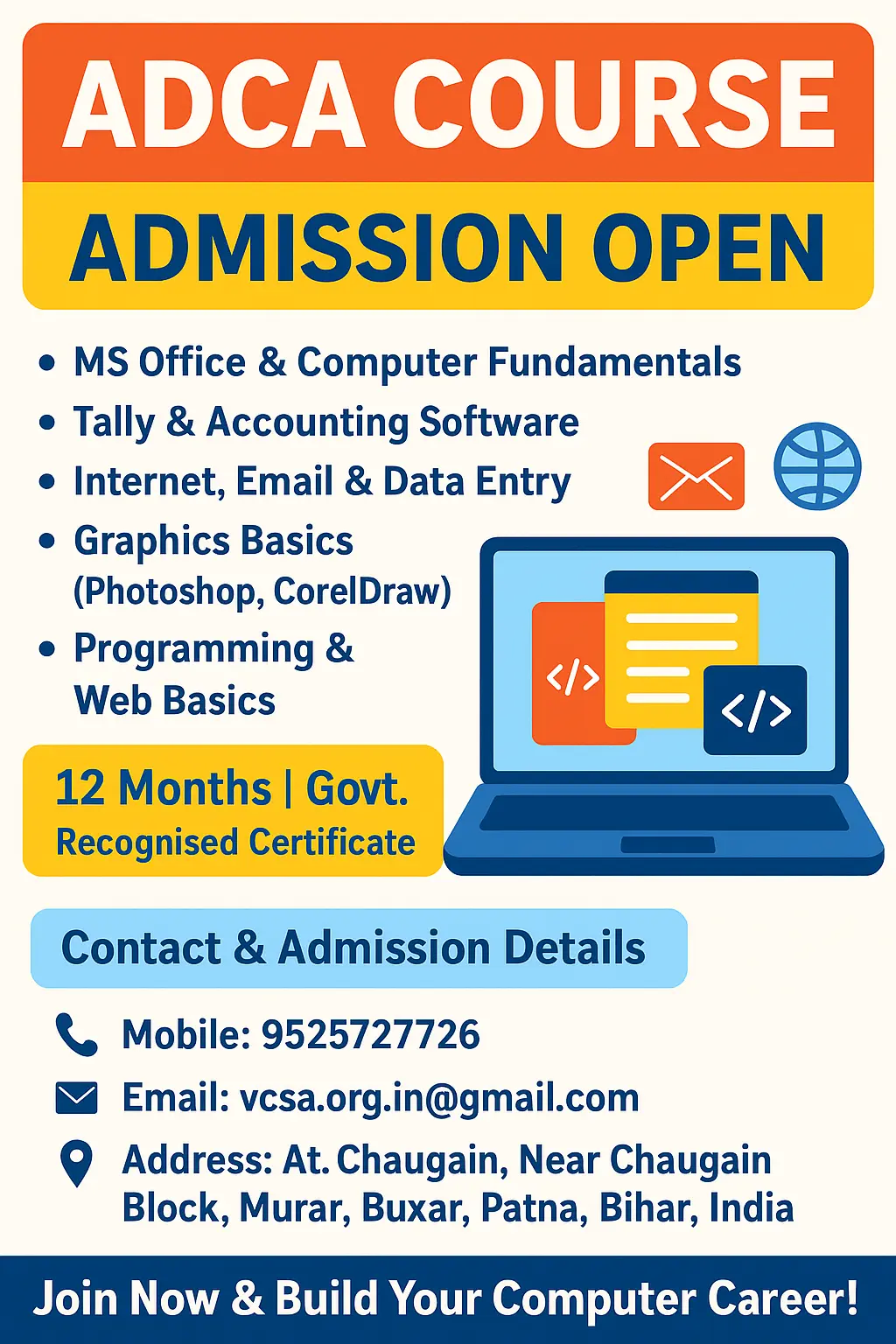
ADVANCE DIPLOMA In COMPUTER APPLICATION(M-CA-4914)

  • Last updated Mar, 2026
  • Certified Course
₹3,600 ₹4,200
  • Duration1 Year
  • Enrolled11
  • Lectures50
  • Videos0
  • Notes0
  • CertificateYes

What you'll learn

VIDEO PROJECT OVERVIEW

Title: ADCA Course – Fundamentals of Computer

Duration: ~45 Minutes

Format: 16:9 (HD)

Style: Professional e-learning (blue, orange, white theme)

Tone: Educational, confident, clear

Target Audience: Computer diploma students (Beginners / ADCA Level)

🧩 STRUCTURE OUTLINE (for Canva scenes)

SectionDurationCanva Scene TypeVisual SuggestionsIntro2 minTitle + instructor welcomeMotion background with laptop animationWhat is a Computer5 minInfographic slidesCPU + student animationIPO Cycle8 minDiagram animationInput–Process–Output flowTypes of Computers7 minCarousel layoutIcons for each type (Super, Mini, Micro)Hardware & Software8 minSplit screen layoutReal image + iconsStorage Devices5 minZoom transitionPen drive, HDD, CloudMemory5 minComparison chartSSD vs HDD animationApplications3 minPhoto montageOffice, hospital, bankRecap2 minText highlight motionKey terms summaryQuiz + Ending2 minAnimated Q&AThank-you slide + next lesson teaser

🎙️ VOICE-OVER SCRIPT (AI-Ready)

[Scene 1 – Intro]

“Welcome to the ADCA course on the Fundamentals of Computer.
In this session, we’ll explore what a computer is, how it works, and why it’s an essential part of every profession today.”

[Scene 2 – What is a Computer]

“A computer is an electronic device that accepts data, processes it, and produces meaningful output.
From banking to education, computers help us make life easier and more efficient.”

[Scene 3 – IPO Cycle]

“Every computer follows the Input-Process-Output cycle.
Input devices like keyboards and scanners send data to the CPU.
The CPU processes it and delivers output through devices like monitors or printers.”

[Scene 4 – Types of Computers]

“There are four major types of computers – Supercomputers, Mainframes, Mini computers, and Microcomputers.
Microcomputers, such as laptops and smartphones, are the most common today.”

[Scene 5 – Hardware & Software]

“Hardware refers to the physical components of a computer.
Software refers to the programs that control how hardware works.
Together, they make the system functional.”

[Scene 6 – Storage Devices]

“Computers store data using devices like Hard Disks, Pen Drives, and Cloud Storage.
Storage capacity and speed determine how efficiently your system performs.”

[Scene 7 – Memory]

“Computer memory is divided into Primary and Secondary memory.
RAM and ROM form the core of primary memory, while hard disks and SSDs store large data permanently.”

[Scene 8 – Applications of Computers]

“Computers are used in every field – education, business, medicine, government, and entertainment.
They save time, reduce errors, and improve productivity.”

[Scene 9 – Recap & Quiz]

“Let’s review what we learned today.
Computers process information using the IPO model.
We covered hardware, software, and types of memory.
Now, answer these quick questions…”

[Quiz Sample]

  1. Define a computer.
  2. Name two input devices.
  3. What is the function of RAM?
  4. Give examples of computer applications.

[Scene 10 – Conclusion]

“Great job completing this session!
In our next ADCA module, we’ll explore the Windows operating system and file management.
Keep learning and keep practicing.”

🎵 AI VOICE & BACKGROUND MUSIC PACK (Recommended)

Voice Style:

  • 🎙️ Male (Neutral) – “Matthew – Clear Educational English”
  • 🎙️ Female (Professional) – “Sophie – Calm Instructor Voice”

Background Music:

TrackTypeDescriptionInspiring BackgroundSoft ambientCalm, tech-friendly introDigital ClassroomLo-fi beatMid-lesson focus toneStudy FlowPiano & light synthRecap sectionOutro TuneGentle upbeatEnding screen

(All can be found under royalty-free platforms like Pixabay Music, Mixkit, or Bensound.)


🧠 READY-TO-UPLOAD CANVA TEMPLATE STRUCTURE

If you want, I can generate a Canva video template JSON file that you can import directly into Canva (each slide timed, with title, subtitle, image placeholder, and voice-over text).

Would you like me to:

👉 create a Canva video file (JSON format) you can upload and edit in Canva?

If yes, please confirm:

  1. Do you want male or female voice style?
  2. Do you want me to include animated icons and motion text overlays?

Once you confirm, I’ll generate the Canva video file + attach free music links.

Show More

Course Syllabus

Fundamental of Computers & Information Technology

Operating System (DOS & Windows)

M.S. Office

Internet

D.T.P

Tally Prime With GST

TYPING ENGLISH 50 WPM

TYPING HINDI 50 WPM

Assignment + Practical

Course Fees

Course Fees
:
₹4200.00/-
Discounted Fees
:
₹ 3600.00/-
Course Duration
:
1 Year

Review

0.0
Course Rating (0 reviews)
0%
0%
0%
0%
0%


Programme

DITRP Self-Employment Courses Programme

DITRP Self-Employment Courses are created for individuals who want to develop practical, skill-based knowledge and generate independent earning opportunities through freelancing, home-based work, local services, professional services, or small business activities. These programs are designed to encourage self-reliance by helping learners build career-oriented skills beyond traditional employment options.

DITRP self-employment training programs offer exposure to a variety of practical and vocational sectors, including beauty and wellness services, tailoring, fashion designing, computer applications, typing, accounting fundamentals, digital marketing, online business promotion, vocational training, and local business support services.

These courses are beneficial for students, women learners, homemakers, rural and semi-urban youth, freelancers, job seekers, beginners, and small business owners who wish to gain practical expertise and explore skill-based earning opportunities through authorized training centres.


Programme

DITRP Job-Oriented Courses Programme

DITRP Job-Oriented Courses are developed to provide practical and career-focused training that helps learners enhance their employability, build confidence, and prepare for professional work environments. These programs emphasize skills that are widely required across offices, businesses, service organizations, educational institutions, digital workplaces, and local employment sectors.

DITRP job-oriented training programs offer practical learning opportunities in various fields, including computer applications, MS Office, Advanced Excel, accounting, Tally, GST, digital marketing, typing, communication skills, soft skills, interview preparation, vocational training, and self-employment-based learning.

These courses are suitable for students, graduates, job seekers, working professionals, women learners, and beginners who aim to strengthen their career prospects and develop industry-relevant skills. Institutions can also partner with DITRP as authorized training centres to provide job-oriented courses and skill development programs within their local regions.


Important: DITRP is an autonomous private skill development and certification organization. DITRP certifications are skill-oriented private certifications created to support career advancement, vocational education, self-employment opportunities, and professional development. As a private organization, DITRP provides Private certifications, and their recognition or eligibility may vary depending on the employer, institution, department, or intended purpose.

DITRP operates as an independent private skill development and certification body. Course structure, training methodology, and syllabus may also be customized according to the teaching approach of the institute or faculty members to ensure effective learning outcomes. The acceptance and applicability of DITRP certifications may differ according to the policies of various employers, institutions, or organizations.

Note: The Course Content & Syllabus provided is intended as a general guideline for the course. The curriculum has been designed considering institutional teaching methods, faculty expertise, learner demand, and industry requirements to ensure practical and effective training. The actual course duration, class schedule, training methodology, and mode of delivery may vary depending on the training institute or course provider. Course content may also be updated or modified from time to time according to learning requirements, industry standards, and regional needs.


Call
Text Message
Review
Email
CHAT